Navigating the Legal and Regulatory Landscape of Global Minimum Tax
Knowledge • Navigating the Legal and Regulatory Landscape of Global Minimum Tax
Knowledge • Navigating the Legal and Regulatory Landscape of Global Minimum Tax
This article will provide an overview of the legal and regulatory considerations that multinational corporations need to be aware of
when dealing with global minimum tax, including the latest updates and best practices.
Global minimum tax rules have brought about a paradigm shift in international taxation, requiring multinational corporations (MNCs) to
navigate a complex legal and regulatory landscape. In this article, we will provide an overview of the legal and regulatory considerations
that MNCs need to be aware of when dealing with global minimum tax, including the latest updates and best practices.
Understanding Global Minimum Tax
Global minimum tax rules, as outlined in the recent OECD/G20 agreement, aim to ensure that MNCs pay a minimum level of tax regardless of where they operate. These rules require MNCs to calculate their global income and tax liabilities, and if their effective tax rate falls below the minimum threshold, they must pay a top-up tax to meet the minimum rate.
Legal and Regulatory Considerations
Complying with global minimum tax rules requires MNCs to navigate a range of legal
and regulatory considerations. These include:
Best Practices for Compliance
To navigate the legal and regulatory landscape of global minimum tax, MNCs should
consider the following best practices:
Conclusion:
Navigating the legal and regulatory landscape of global minimum tax requires careful planning and compliance with a range of legal and regulatory requirements. By staying informed, seeking professional advice, and implementing robust compliance systems, MNCs can ensure they meet their tax obligations and avoid potential penalties.
Seek guidance from specialised tax and legal experts to ensure international tax compliance.
We are honored to be selected among many companies in Singapore to share our story; an excellent read about the human side of transfer pricing and why we love what we do.
We are delighted to announce Shannon Smit, Lead Partner of Transfer Pricing Solutions, as the winner of Partner of the Year – Boutique Firm at the Australian Accounting Awards 2016 organised by Accountants Daily.
As we see the Pokemon Go fever going up around the world, we were interested in knowing why is the world so excited about this game.
We all recovering from the Rio 2016 Olympic Games fever and coping with ‘the Olympic blues’ by following another sportive event or anxiously waiting for the next four years to go by and see our world athletes in Tokyo 2020.
With Australia’s new transfer pricing landscape and BEPS world, intercompany loans are viewed as high risk by Tax Authorities. We have compiled below Frequent Ask Questions from clients that can help you understanding what you need to do to mitigate transfer pricing risks associated with intercompany loans.
With the final reports of the BEPS Action Plan released in October by the OECD and the new transfer pricing documentation standard, a benchmarking analysis that is reliable and defendable is key when preparing transfer pricing documentation.
The Singapore Ministry of Finance announced on 16 June 2016 its commitment and intention to implement the BEPS Action Plan. Singapore will commence a consultation with Multinational Enterprises (MNE) on the implementation of Country By Country (CbC) Reporting and will release details on the outcome in September 2016.
On 15 June 2016, the OECD Council approved the amendments to the ‘Transfer Pricing Guidelines for Multinational Enterprises and Tax Administrations’ (Also as the OECD Transfer Pricing Guidelines). The changes are the most significant amendments introduced into the OECD Transfer Pricing Guidelines since 2010.
With transfer pricing gaining so much attention, we have seen an increased interest in accountants wanting to partner with us and outsource part or all of their transfer pricing.
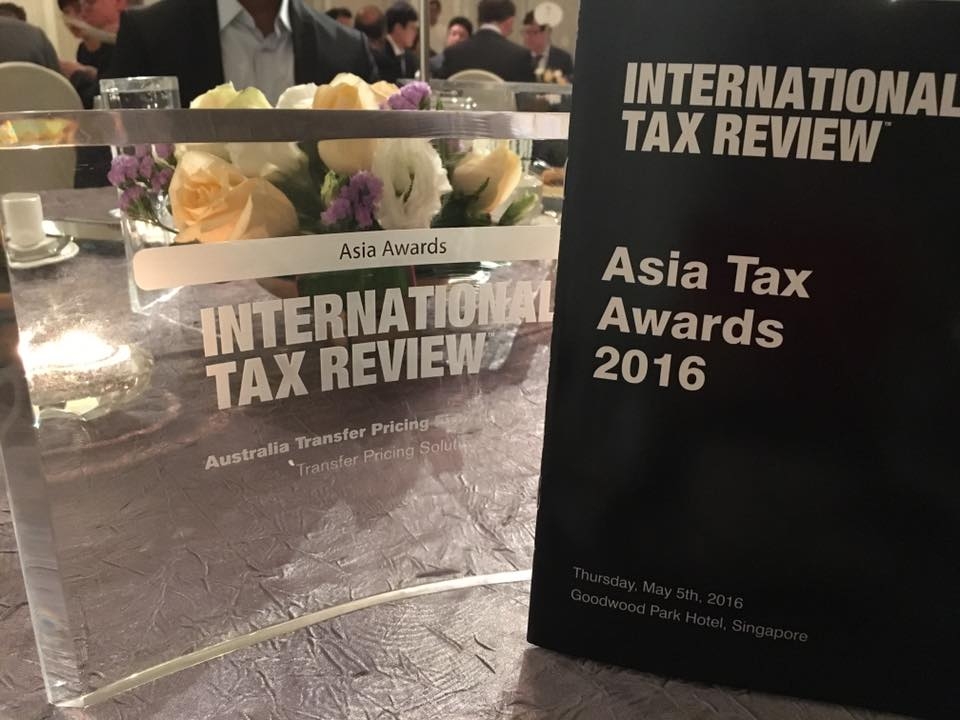
We are delighted to announce Transfer Pricing Solutions as the winner of Australia Transfer Pricing Team of the Year in the Asia Tax Awards 2016 organised by the International Tax Review. The Asia Tax Awards.
The Australia Federal Budget introduced fundamental tax measures that reinforce the Government commitment to tax transparency. Since the released in October 2015 of the final reports from the OECD BEPS Action Plan, Australia has taken significant steps to address the issue of tax avoidance including
On 26 April 2016, The Australian Taxation Office (ATO) released four of Tax Alerts warning multinationals and their tax advisors on potential profit-shifting arrangements that will be closely examining to identify any attempts of tax avoidance.
In the Asia-Pacific Region, Australia, and Japan have both been on the front foot of the BEPS action plan changes releasing legislation to introduce CbC Reporting. It is expected that all countries in the Asia-Pacific Region will introduce the CbC Reporting as it is a key element of the BEPS Action Plan agreed by all 34 OECD member countries, G20 nations, and other nations which joined the BEPS discussions at the OECD.
Transfer Pricing Solutions (TPS) is pleased to reveal a new website to boot!
www.
The CbC Reporting has created a ‘BEPS wave’ in the industry and has become an area of focus for tax practitioners, with many countries releasing new legislation and reporting requirements for multinational enterprises (MNE).
Transfer Pricing Solutions is growing. As an industry leader in the Asia-Pacific Region, we are delighted to announce the opening of our new entity located in Singapore. Transfer Pricing Solutions Asia allows us to cement our expertise in transfer pricing solutions in one of Asia’s largest financial centres, increasing our presence in the region
Transfer pricing remains in the eye of the Australian Taxation Office (ATO) with further developments on the enforcement of Australia’s multinational anti-avoidance law (MAAL). The spotlight on the anti-avoidance law affirms Australia’s commitment to enforcing tax transparency and the implementation of BEPS Action plan.
The ATO is currently focusing on reviewing arrangements involving the use of offshore procurement hubs that source goods on behalf of Australian resident multinational enterprises (MNEs).
In the most recent Tax Payer Alert TA 2015/5, the ATO announced that is focusing on structures where the procurement hub offshore is sourcing goods on behalf of the Australian MNE and is also receiving services from another related party entity located offshore (Service hub).
On 3 December the federal government passed the Tax Laws Amendment (Combating Multinational Tax Avoidance) Bill 2015. The Bill implements the recent guidance set by the OECD as part of its Base Erosion and Profit Shifting (BEPS) initiative with respect to Action Plan 13 by introducing a new transfer pricing standard.
On 26 November the ATO provided further guidance on the application of the STPR options in the form of Frequently Asked Questions (FAQ). In the document, the ATO emphasises on the importance of demonstrating compliance with Australia’s transfer pricing rules, even when applying the STPR options.
We are hearing a lot are having trouble understanding what contemporaneous documentation really means and what are the practical implications. Read our case study as we summarise our experience with the most common misunderstandings.
As published in The Age on 23rd November 2015, the ATO is quoted to take a tighter approach to deal with multinationals on future taxes, meaning agreeing up front in the form of an Advance Pricing Arrangements. The ATO is becoming more ‘picky’ about entering into agreements and has delayed some renewals with major multinationals.
The Chevron case is a big win for the Commissioner and will definitely give confidence to the Australian Tax Office to pursue more transfer pricing cases, although it is expected that with a potential $322 million tax bill, Chevron will appeal.
With conflicting requirements, Year End Financial Statement auditors are in many cases declining to sign off on audits where there is no ‘evidence’, a company has satisfied the new transfer pricing requirements. The quandary for many companies is how to achieve this when transfer pricing documentation is not required to be prepared until approximately 6 months after year end, whilst the auditors come in 2 months after year end.
On September 16 the OECD released guidance on transfer pricing topics as part of the Base Erosion and Profit Shifting (BEPS) Action Plan announced in July 2013. These topics include guidance on Action 13 on transfer pricing documentation and country-by-country reporting.
Intercompany loans continue to be a hot topic and focus point for the Tax Authorities around the world as this type of transactions are considered high risk from a transfer pricing prospective. If your company has entered into intercompany loans it is critical to assess any transfer pricing risk related with the transaction and to have evidence of compliance with the arm’s length principle.
The Australian Treasury has released exposure draft legislation (Subdivision 815-E) to implement new OECD standards on transfer pricing documentation (Master File and Local File) and Country-by-Country (CbC) reporting. The new draft legislation makes Australia the second country (after Spain) to release legislation on this issue as a direct result of the recent guidance set by the OECD as part of its base erosion and profit shifting (BEPS) initiative with respect to Action Plan 13: Guidance on the Implementation of Transfer Pricing Documentation and Country-by-Country Reporting.
The Australian Treasury released an exposure draft bill to impose stronger penalties to combat tax avoidance and profit shifting. The draft legislation will apply to companies with annual global revenue exceeding AU$1 billion that are obliged to comply with the Country by Country (CbC) reporting.
The Australian Taxation Office (ATO) has released a new process for advance pricing arrangement (APA) negotiations (Practice Statement, PS LA 2015/4). The new process will apply to all ongoing APA negotiations and future APA requests (both new APAs and renewals). The APA program has been updated to ensure it reflects changes in global economy and the ATO’s anti-profit shifting work.
The new process includes three key steps as follows:
The OECD Releases the New Global Standard on Transfer Pricing Documentation- What do you need to do today? On September 16 the OECD released guidance on transfer pricing topics as part of the Base Erosion and Profit Shifting (BEPS) Action Plan announced in July 2013. These topics include guidance on Action 13 on transfer pricing